Common kinds of tears
A clean rip. The photo tore in one line, often across a fold, and both pieces still exist. This is the easiest case: the pieces are lined up in the copy and the seam is repaired.
A missing corner or edge. Old prints were handled by their corners for decades, so corners are what break off. The missing area is rebuilt to match what surrounds it: a wall, a curtain, the edge of a dress.
A tear through a person. Harder, but still common to repair well, as long as the features on both sides of the tear are visible.
Creases and folds. Not quite tears, but a hard crease breaks the surface of the print and leaves a white line. These are repaired the same way as a fine tear.
Lost pieces in the middle of the photo. The most difficult. If the missing piece held a face, restoration cannot recreate who was there; it can only fill the gap to match the surroundings.
A torn wedding photo, repaired
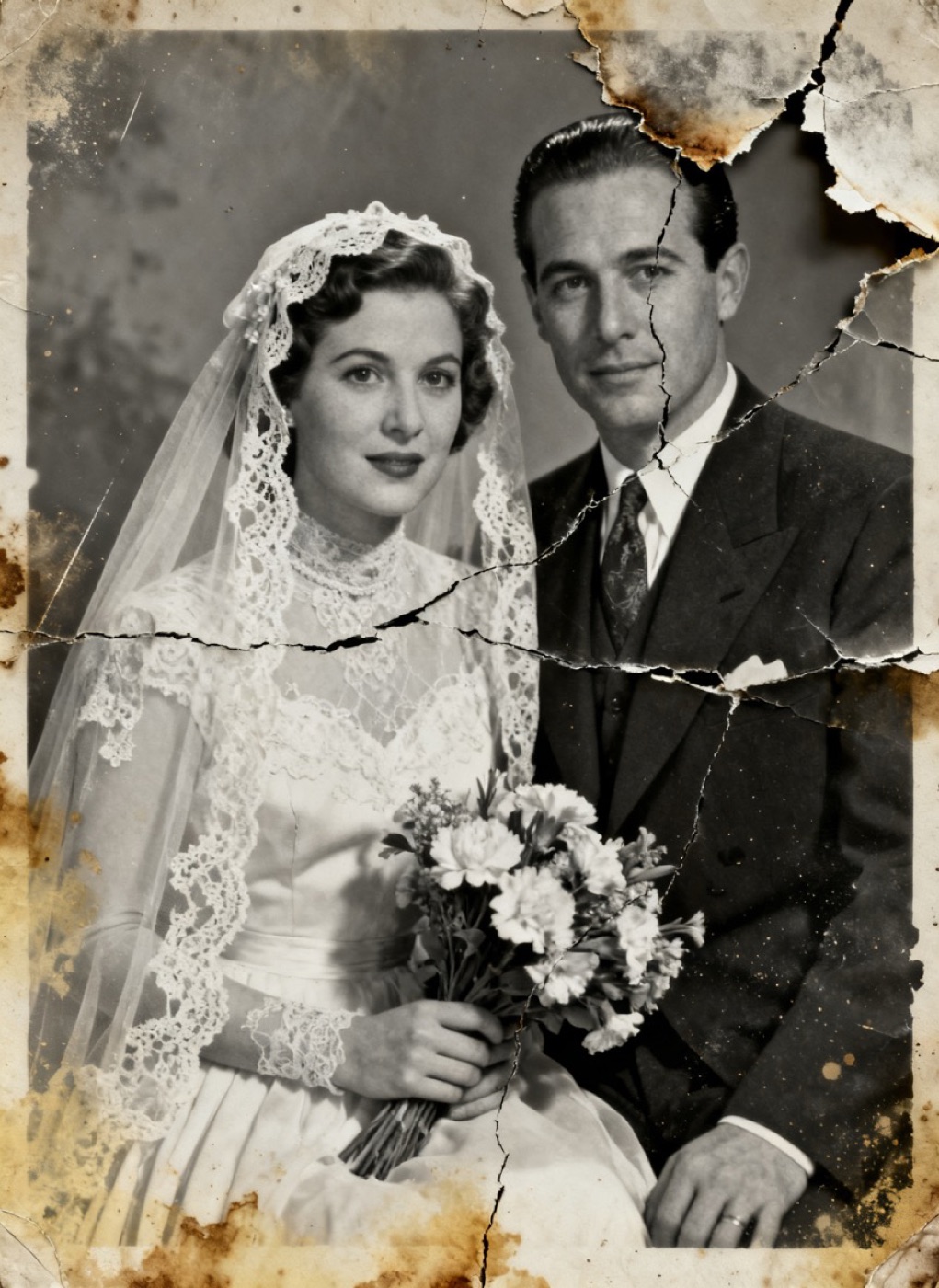
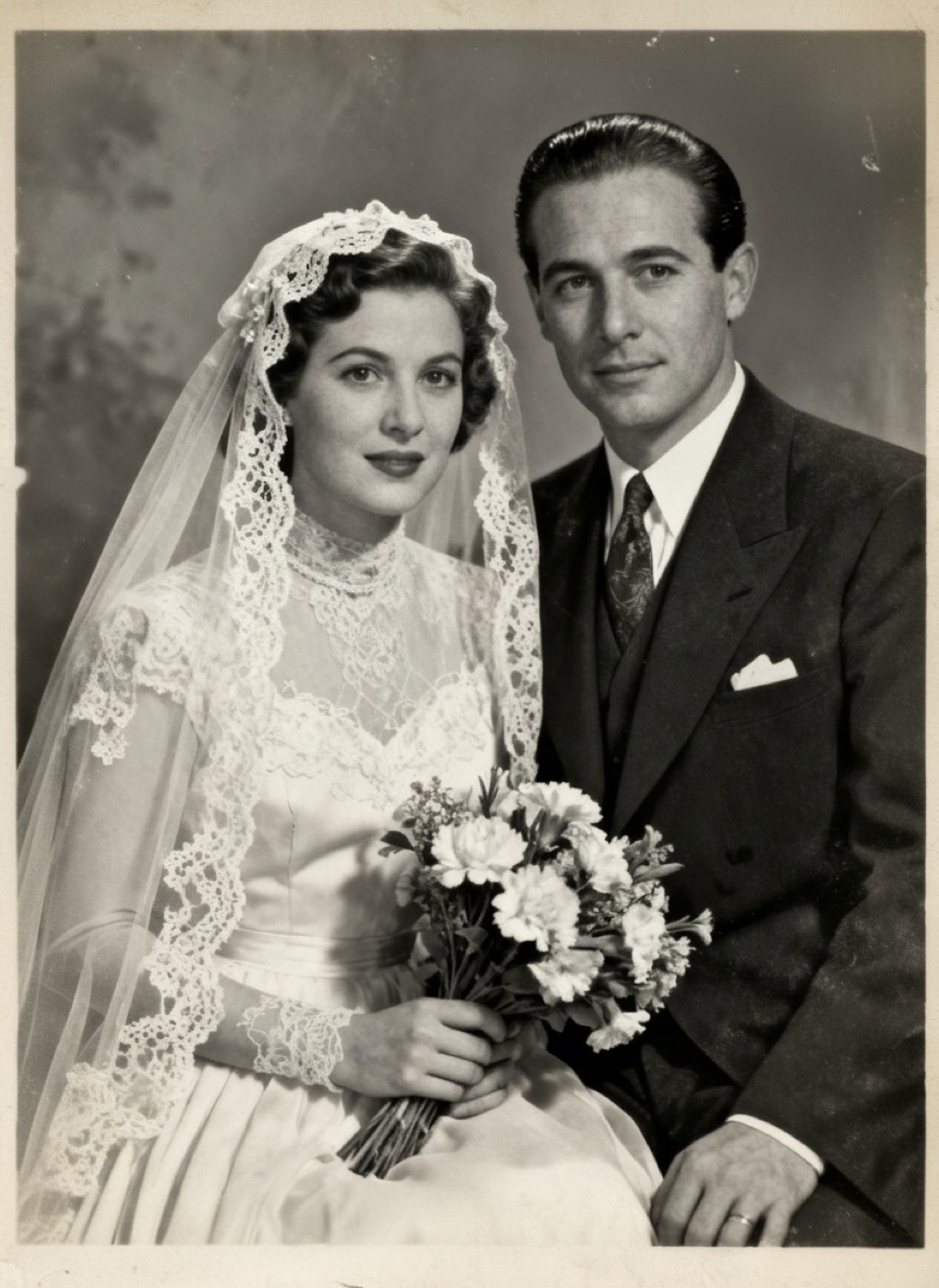
Wedding day, about 1946. Torn corner rebuilt. Cracks mended. Stains lifted.
This wedding portrait from about 1946 had a torn upper corner, cracks across the faces and water stains along the edges. The restored version rebuilds the corner to match the lace of the veil and the shadow on the wall, mends the cracks and lifts the stains. The couple's faces are exactly as they were; we never change who is in a photo.
What to do with a torn photo right now
Before anything else, stop the damage from spreading.
- Do not tape it. Ordinary tape yellows, its adhesive seeps into the print, and removing it later can lift the image with it. Plenty of old photos were taped decades ago, and the tape stains are often worse than the tear.
- Do not glue it. For the same reason.
- Keep all the pieces together. Put the pieces in an envelope or a sleeve with the photo, even tiny fragments.
- Store it flat. A torn print tears further when it is bent. Put it between two pieces of clean card in a folder.
If the photo was already taped years ago, leave the tape alone unless it is actively peeling. Tape stains show up in the copy, and they can be cleaned up in the restoration.
How to copy a torn photo
You do not send us the original, only a copy.
- Lay the photo flat on a dark, plain surface, like a sheet of dark paper. A dark background makes the edges of the tear easy to see.
- Put the pieces back in place, edge to edge, as closely as you can. Do not overlap them.
- Use soft daylight and no flash. Hold the phone directly above, parallel to the table.
- If the pieces will not lie flat, place a clean sheet of glass from a picture frame over them, and watch for reflections.
A flatbed scanner works well too, and the glass holds the pieces in place. Our guide to scanning old photos covers both methods in detail.
Tears plus other damage
Torn photos rarely have only one problem. A photo that tore was usually handled a lot, folded, or stored somewhere damp, so tears often come with cracks, stains or fading. The restoration handles all of it at once. If your photo also has a network of fine cracks in the surface, our guide to cracked photos explains what causes that.
If your torn photo is a wedding or family portrait from the 1940s, our guide to 1940s photos covers that era in more detail.
Printing the repaired photo
The restored photo is printed with a clean white border, keeping the whole picture: nothing is cropped unless you ask. Choose 5x7, 8x10 or 8x12, in a lustre or glossy finish, and as many copies as you need for the family. Every print arrives in its own protective sleeve with a stiff backing board.
Send a scan or a phone photo of the print. See the restored result before you pay.
Repair a torn photoUpdated October 8, 2026