Why old photos crack
Most photographic prints are layered: paper or card at the bottom, and a thin image layer on top. The two layers react differently to heat and humidity. Over decades of swelling and shrinking, the more brittle image layer gives way.
- Crazing is a fine web of cracks across the whole surface, common on old card mounted portraits and prints stored in dry, hot places.
- Flaking happens when cracked pieces of the image layer lift and fall away, usually at the edges and corners where photos are handled.
- Bending cracks follow a line where the photo was folded, rolled or bent. Cabinet cards and photos kept in wallets often have them.
- Scratches are not cracks but are often lumped together with them: lines dragged through the surface by grit, other photos or fingernails.
Two other kinds of surface damage often appear alongside cracks. Foxing is a scatter of small brown or reddish spots, usually from moisture and impurities in the paper. Silvering is a bluish metallic sheen in the dark areas of black and white prints, caused by silver migrating to the surface.
A cracked portrait, mended
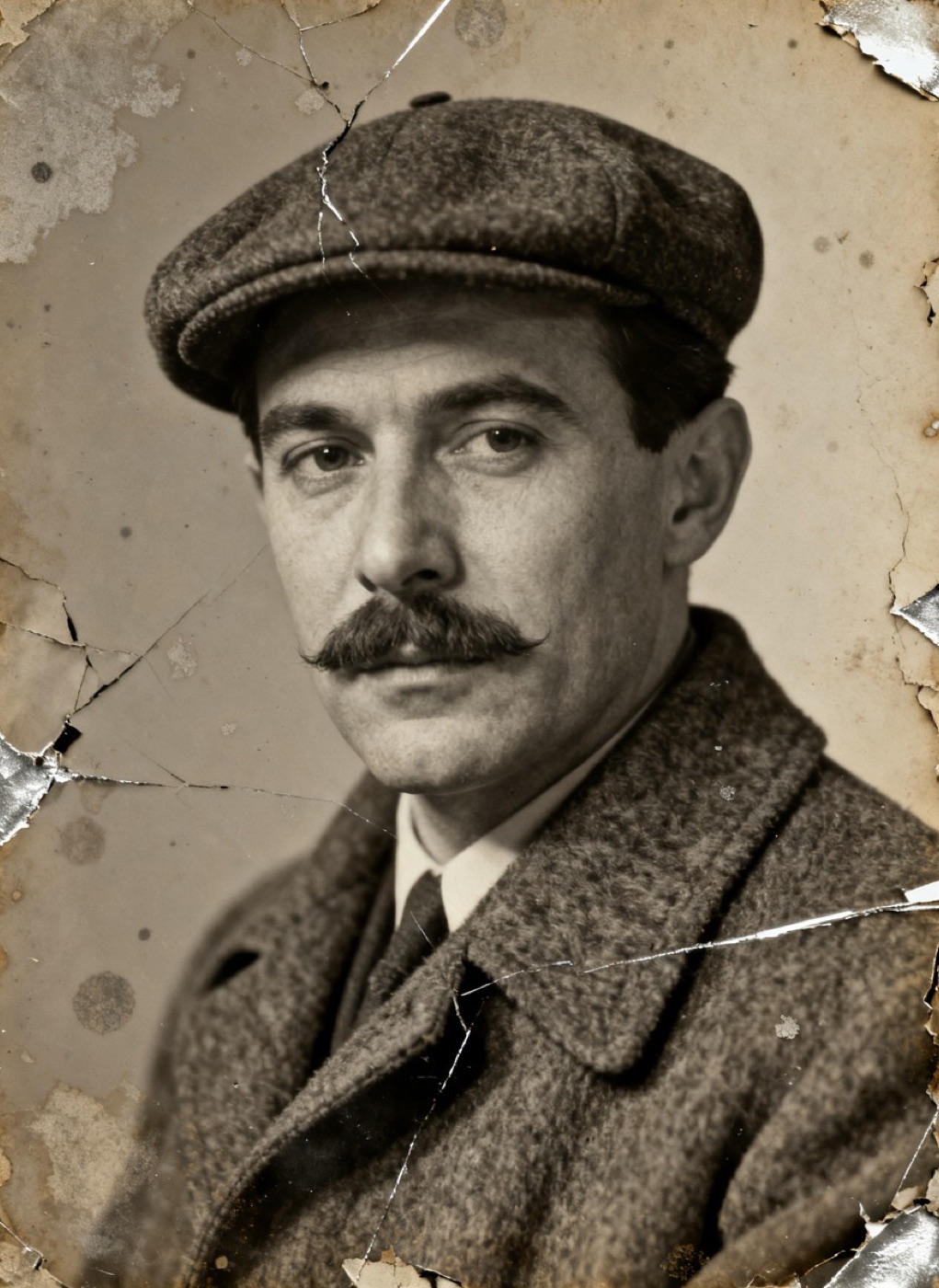

Grandpa in his flat cap, about 1934. Cracks mended. Flaked edges rebuilt. Spots removed.
This studio portrait of a man in a flat cap, from about 1934, had deep cracks, flaked edges and spots across the background. The restored version mends the cracks, rebuilds the flaked edges and removes the spots. His face stays exactly his: restoration repairs damage and never changes the person.
Handling a fragile, flaking photo
A flaking photo loses a little more every time it is handled. Before copying it:
- Do not touch the surface. Hold it by the edges, ideally with clean, dry hands or cotton gloves.
- Do not flatten a curled, cracked print by force. It will crack further. Photograph it as it is.
- Do not brush or wipe it. Loose flakes are part of the picture and can sometimes be photographed in place.
- Keep it in a rigid folder or between two pieces of clean card, flat, so it cannot bend.
Copying a cracked photo
Light direction matters more for cracked photos than for any other kind of damage. Light that skims across the surface at a low angle makes every crack and flake cast a shadow and stand out. Light that falls evenly from the front shows the image and hides the cracks.
- Use soft, even light from a window, not a desk lamp from one side.
- No flash. It catches the raised edges of every crack.
- Phone directly above, parallel to the photo.
- A flatbed scanner works well for flat prints, since its light is even and frontal. Do not press down on a curled or flaking print.
Our guide to scanning old photos covers settings for both methods.
Which photos crack most
Cracking is most common on photos mounted on card, because the stiff card and the thin image layer fight each other. The cabinet card guide covers the most common type from the late 1800s. Tintypes, which are on thin iron, crack and flake when they are bent, and they rust where the coating breaks; see our tintype guide. Photos that were torn as well as cracked are covered in the torn photos guide.
After the repair
The restored photo is printed with a white border around the whole picture, in black and white or with color added, on lustre or glossy photo paper. The new print can go in a frame on the wall, and the cracked original can go into dark, stable storage where it will last much longer.
Send a scan or a phone photo of the print. See the restored result before you pay.
Repair a cracked photoUpdated October 8, 2026