The short answer
Choose lustre for most restored photos, especially anything going in a frame, on a wall or into a family member's hands. Choose glossy when you want the deepest blacks and most vivid color and the print will be viewed up close, in an album or on a desk, away from bright windows.
Lustre is the default on our order page for that reason.
What each finish looks like
Lustre has a soft sheen and a very fine texture, sometimes described as a pebbled or eggshell surface. It sits between glossy and matte: colors are rich and blacks are deep, but light from a window or lamp spreads out instead of bouncing straight back. Fingerprints barely show.
Glossy is smooth and shiny, like a classic drugstore print. It gives the strongest contrast, the darkest blacks and the most saturated color, and fine detail looks crisp. The trade off is reflection: under bright light or from an angle, the surface can mirror the room, and fingerprints show easily.
What about matte?
Many people search for glossy or matte. A true matte paper has no sheen at all, which kills glare entirely but also flattens the deepest blacks a little. Lustre was designed as the middle ground: most of the glare control of matte, with most of the richness of glossy. That is why it is the standard choice for professional portrait prints, and why we offer it instead of a flat matte.
Side by side
| Lustre | Glossy | |
|---|---|---|
| Surface | Soft sheen, fine texture | Smooth, high shine |
| Glare | Low | High in bright light |
| Fingerprints | Barely visible | Show easily |
| Blacks and contrast | Deep | Deepest |
| Color | Rich | Most vivid |
| Best for | Frames, walls, gifts, handling | Albums, close viewing, vivid color |
Which finish for an old photo?
Black and white restorations. Lustre is our pick. Restored black and white photos are all about tone: the gradation from deep shadow to clean highlight. Lustre shows that range without glare getting in the way, and it feels close to the soft surfaces of many original prints.
Color restorations. Either works. Glossy makes colors pop, especially in outdoor scenes. Lustre keeps skin tones soft and natural and is easier to view on a wall. Our colorizing guide explains how color is added to old photos.
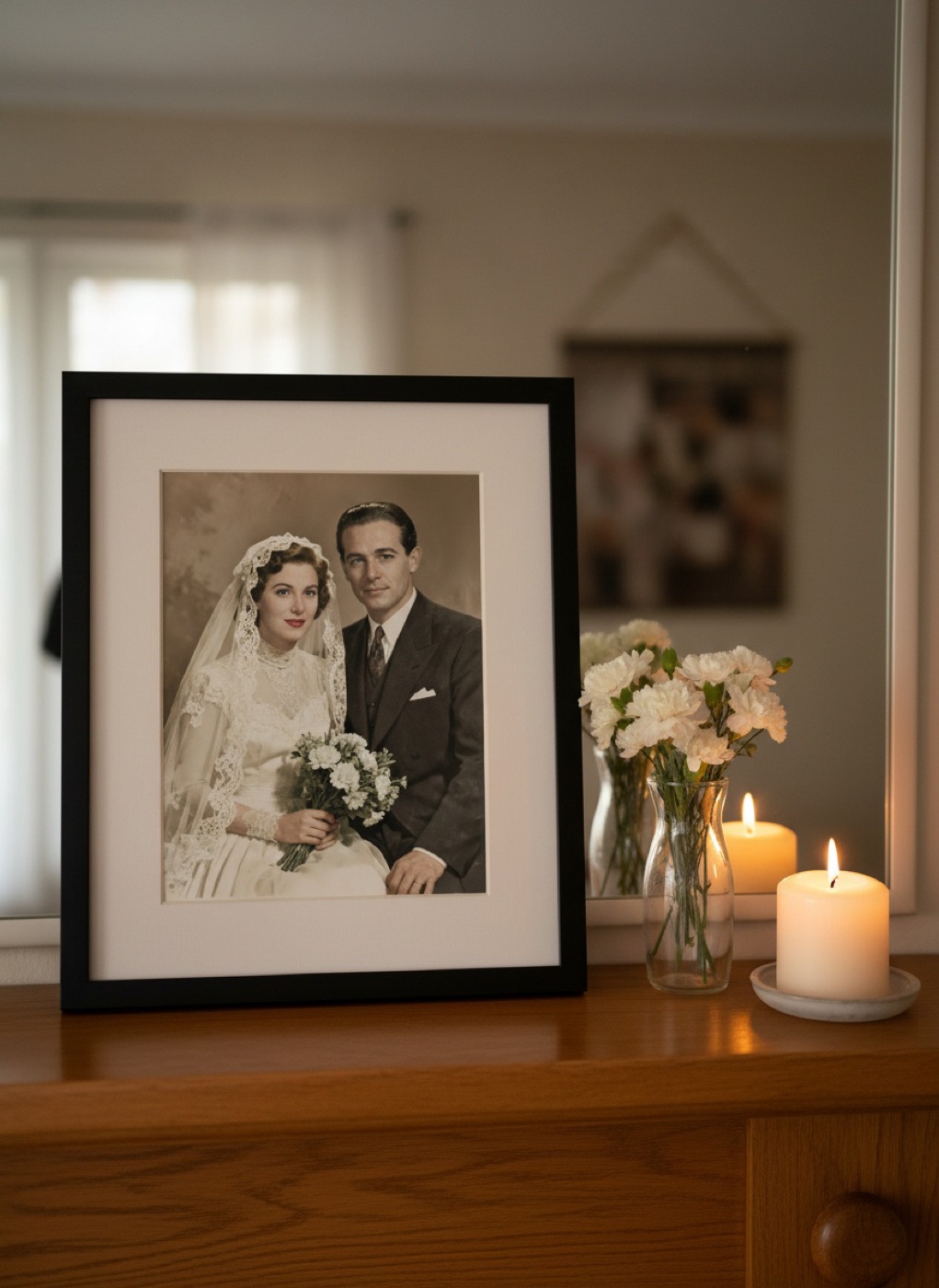
Prints for framing. Lustre. Behind glass, a glossy print adds a second shiny surface, which can mean double reflections. Lustre reduces that.
Prints that will be handled. Lustre, because it hides fingerprints. Think of a print passed around at a family reunion or tucked into a card.
Prints for a memorial service. Lustre. Display boards and easels sit under bright, mixed lighting, and lustre stays readable from every angle while people gather around.
Matching an original glossy snapshot. Many 1950s and 1960s snapshots were printed glossy. If you want a reprint that looks and feels like the original, glossy is a nice touch.
Caring for either finish
Hold prints by the edges, keep them out of direct sun, and store them in archival sleeves. Each of our prints arrives in its own protective sleeve with a backing board. Glossy prints can stick to glass or to each other if they get damp, so keep them dry and do not stack them face to face. More in our guide to storing old photos.
Paper finish and price
The finish does not change the price: the same size costs the same on lustre or glossy, with restoration and free shipping included. Our restoration cost guide has the full breakdown.
Send a scan or a phone photo of the print. See the restored result before you pay.
Choose your printUpdated October 8, 2026